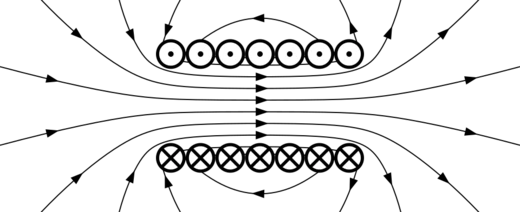
Magnetic resonance
A magnetism-based resonance process enabling imaging and spectroscopy.

Magnetic resonance occurs when magnetism creates a physical resonance, or excitation. This phenomenon led to the creation of magnetic resonance imaging (MRI) and nuclear magnetic resonance spectroscopy (NMRS). It is also currently being explored for use in nuclear magnetic resonance quantum computers.
The first detection of electron-spin resonance happened in 1944, carried out by Soviet physicist Y. K. Zavosky while teaching at what is now Kazan Federal University. In 1946, two separate American teams—one led by Felix Bloch and another by Edward Mills Purcell—each observed nuclear magnetic resonance. Both men later shared the 1952 Nobel Prize in Physics.
To measure the gap between two energy levels, one natural approach is to find a measurable quantity defined by that gap and measure it directly. However, this method is limited by the precision of the measurement and can be inaccurate. An alternative is to design an experiment where the system’s behavior depends on the energy levels. By applying an external field with a controlled frequency, the level separation can be determined by noting the frequency at which a qualitative change occurs—this indicates a high probability of transition between the two states. One example is a variation of the Stern–Gerlach experiment, where the magnetic moment is measured by finding the resonance frequency for a transition between two spin states.
- first_observation_electron_spin_resonanc
- 1944 by Y. K. Zavosky
- first_observation_nuclear_magnetic_reson
- 1946 by teams led by Felix Bloch and Edward Mills Purcell
- nobel_prize
- 1952 in Physics to Bloch and Purcell
- applications
- MRI, NMRS, quantum computing
Lore & Background
The first observation of electron-spin resonance was in 1944 by Y. K. Zavosky, a Soviet physicist then teaching at Kazan State University (now Kazan Federal University). Nuclear magnetic resonance was first observed in 1946 in the US by a team led by Felix Bloch at the same time as a separate team led by Edward Mills Purcell, the two of whom would later be the 1952 Nobel Laureates in Physics. A natural way to measure the separation between two energy levels is to find a measurable quantity defined by this separation and measure it, but precision may be poor. Alternatively, an experiment can be set up in which the system's behavior depends on the energy level; applying an external field of controlled frequency allows measurement of the level separation by noting at which frequency a qualitative change happens, indicating a high probability of transition between two states. An example is a variation of the Stern–Gerlach experiment, in which magnetic moment is measured by finding resonance frequency for the transition between two spin states.
Reader's Guide
Magnetic resonance is significant as the foundational process behind two major technologies: magnetic resonance imaging (MRI) and nuclear magnetic resonance spectroscopy (NMRS). MRI has become a crucial medical diagnostic tool, while NMRS is widely used in chemistry and biochemistry for molecular structure determination. Additionally, the process is being applied to develop nuclear magnetic resonance quantum computers, representing a frontier in quantum information science. The historical observations by Zavosky, Bloch, and Purcell established the experimental basis, with Bloch and Purcell sharing the 1952 Nobel Prize in Physics for their work. The method's ability to measure energy level separations via resonant frequency has proven versatile, enabling both practical applications and fundamental research. Its legacy continues to expand as new uses emerge in computing and other fields.
Did You Know?
- The first observation of electron-spin resonance was in 1944 by Y. K. Zavosky, a Soviet physicist then teaching at Kazan State University.
- Nuclear magnetic resonance was first observed in 1946 in the US by teams led by Felix Bloch and Edward Mills Purcell.
- Bloch and Purcell were the 1952 Nobel Laureates in Physics for their work on nuclear magnetic resonance.
- A variation of the Stern–Gerlach experiment measures magnetic moment by finding resonance frequency for the transition between two spin states.
More in Electromagnetism And Radiation 1-20
Spotted an error? Know more?
This is a living reference — every entry is fact-audited, and reader corrections feed straight into our audit queue. Suggest an edit · See this site's audit record